

06 October 2016
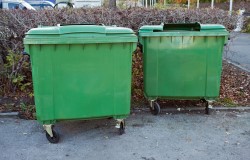
© elkoplast.eu – skip containers
 The history of garbage collection is one of rich innovation and necessity-driven creativity. Many aspects of garbage collection seem to converge over time to one clearly superior solution, phasing out old techniques along the way. For example the rotary garbage truck is almost completely obsolete with today’s hydraulic-based hoppers. There is however one area that seems to be diverging: skips. For those who do not know, skips or dumpsters are containers for waste disposal, most commonly used in construction projects. Although skips have undergone several transformations throughout history, today they are offered as a solution to garbage disposal in a variety of shapes and sizes.
Skips are a basic concept dating back to their first appearance in the United Kingdom around 1960s, but were prevalent even earlier than that. In post-war Germany, constant waste disposal was becoming too costly for builders to pay for. In turn, George Cross and Co came up with a game changing solution. By grouping trash in a collectable bin, disposal efforts could be made more efficient as a single collector could make bi-weekly rounds, emptying every bin or skip at the local dump. As a result the cost of disposal plummeted, a saving grace in the economic havoc of the times. In the less dire area of Great Britain, skips also helped to solve a pressing problem. A large number of construction workers would leave trash in an ever-growing rubble heap. Needless to say, these heaps were much harder to remove, consuming precious time and manpower. With the introduction of skips, construction was made tidier and more efficient. This concept of segmented skips was fundamental to much of today’s disposal system, as garbage cans can even be perceived as a type of more personal skip.
Today skips come in all shapes and sizes. Of the most prominent types there exist the aptly named Mini Skip, Midi Skip, and Maxi Skip. These skips hold two, four, and eight tons of waste respectively. Additionally these skips can be designated for all garbage or certain types of waste like soil products. All of these skips can be easily hauled away by the garbage disposal company. Skips are also classified in another dimension. Larger skips can either be open or enclosed. Open skips allow easier loading while enclosed skips more securely hold waste, preventing others from hijacking the skip, loading unwanted waste, and leaving the skip owner to pay for its disposal. And for the largest jobs there is a separate classification of skip available: the roll on, roll off skip. These roll on, roll off (RORO) skips hold anywhere from fifteen to sixty cubic yards of waste, ideal for larger chunks of waste like sofas. These skips can be easily rolled onto or off of the disposal vehicle, allowing incredible efficiency. The diversity of skip sizes and types just goes to show how vital skips are to the current waste disposal system, especially in the field of construction. Since the early 1900s, skips have played an essential role in reducing construction waste, and furthering the development of waste management.

Request a quote
go to top